Yamanashi Kofu Early Music Contest
1995 – 2026Copyright © 2026 CBH


Yamanashi Kofu Early Music Contest1995 – 2026Copyright © 2026 CBH |
|
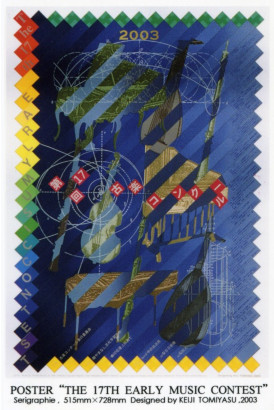 KEIJI TOMIYASU 2003 |
| Poster design for the 2003 Yamanashi Contest |
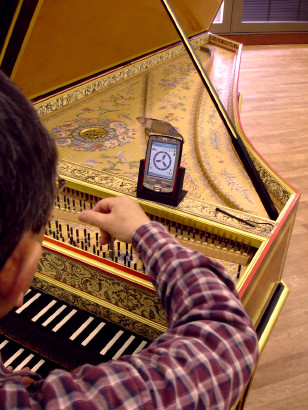 |
| Haruo Hikino tuning the
Marc Ducornet Ruckers/Taskin using the Verituner Pocket program on his HP iPAQ hx279 for the first round in 2009. |
 NASA VISIBLE EARTH |
It was with great sadness news was received that Ms Tsuneko Arakawa, since inception the chair of the organizing committee for the International Competition for Early Music, Yamanashi, had passed away while in Germany in June 2026. Without her infectious enthusiasm and great love of the music, it seems the 37th Competition (April 2026) must be the last.
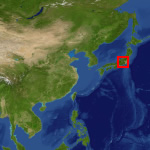
For over thirty years at cherry blossom time, the Japanese early music people gathered in the city of Kofu in Yamanashi Prefecture, a little to the west of Tokyo. There is a phenomenal amount of harpsichord activity in Japan, and this was clearly shown by the large number of Japanese makers who congregated to show their wares every second year for the Harpsichord Competition held at various venues in Kofu City.
The Competition has its own website. The focus was on harpsichord and fortepiano every second year; with vocalists and melodic instruments in alternate years. Not so well known outside Japan, only relatively recently were entries received from a few foreign harpsichordists.
The panel of distinguished judges, however, always included a Westerner: Over the years Bob van Asperen, Anne Marie Dragosits, Martin Gester, Ketil Haugsand, Robert Hill, Jan Willem Jansen, Françoise Lengellé, Lars Ulrik Mortensen, Glen Wilson, Julien Wolfs, Aline Zylberajch and others have taken part. A high standard was preserved when the jury frequently decided not to award particular prizes. In 2007, for example, there were two equal 3rd prizes; in 2009, two equal 2nd prizes; in 2012, a third prize and an encouragement award; and no first prizes were awarded in any category in 2016.
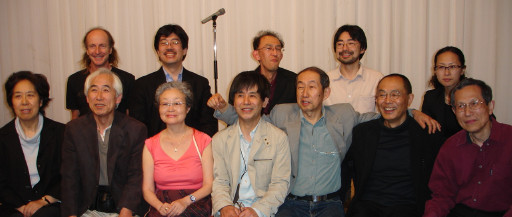
Since 1995, my colleague Tae Ioka from L’Oiseau-Lyre House co ltd always invited me to assist in Yamanashi with her technician Haruo Hikino. Marc Ducornet joined us a few times from Paris, as Tae has been active for many years in providing his instruments from her premises in Osaka and Tokyo. In 2003, we helped open Tae’s new shop close to Akihabara in Central Tokyo—the featured harpsichordist being Yoshio Watanabe. The only other European makers who have ever visited Yamanashi in my time are Joop Klinkhamer with Anton Amir, and Guido Bizzi.
The camaraderie amongst the local makers always astonished me—and is not so readily seen in other parts of the world: All assisted in the unloading of the multiple early keyboards in the car park, the negotiation of the goods lift, and the long corridors and ramps before arrival in the upstairs exhibition room of Kenmin Bunka Hall with one entire wall a panoramic picture window facing Mt Fuji.
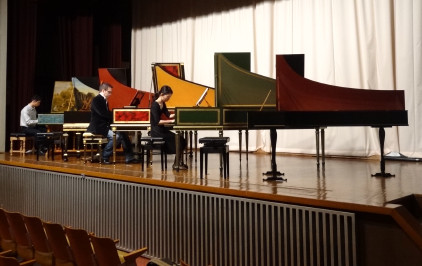
As soon as the first few instruments were unpacked and setup, the competitors swarmed into the room and scrambled for last-minute practice. It’s wall-to-wall cacophony, as you can hear from the movies below. In the quieter moments, the makers were able to compare notes and study every instrument with interest. The early rounds of the contest were held in an intimate studio with perhaps only a few harpsichords and organ for the competitors to play. Then the contest moved to the main stage, with the finalists able to choose whichever instruments they desired any of those exhibited. On the last day there were often six or more early keyboards onstage, with strictly allocated tuning time!
 CAREY BEEBE |
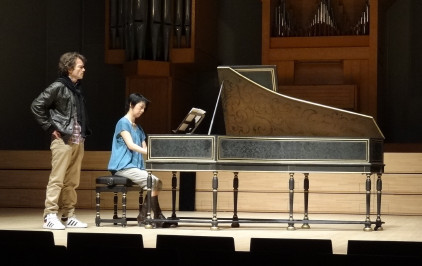
| Christophe Rousset & Mayako Soné at the Marc Ducornet Colmar copy |
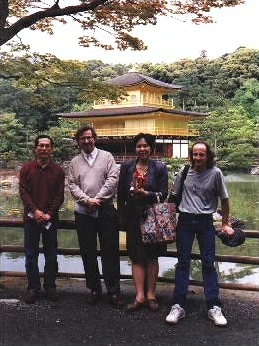
Yamanashi always provided an intense and action-packed three days for me, and then we often had to load up and rush with the instruments to Tokyo or Osaka for concerts or masterclasses by the visiting European the next day. Fortunately, some years have been more leisurely, with the travel providing us an opportunity to visit a most beautiful part of the world at its best season. We’ve enjoyed Kyoto, Lake Biwa, Nikko and Mt Fuji, as well as the important collection at the Hamamatsu Museum of Musical Instruments—and you can’t go to that city without sampling the famous unagi (eel).
The Contest was due to reach its 25th year in 2011, this milestone marked with a new name: The Early Music Festival, including International Competition for Early Music, Yamanashi. It was to be held as usual over the last weekend in April, but because of the devastation of the March 11 earthquake and tsunami—and especially the uncertainty of the effects of radiation from Fukushima—it was regretfully postponed to 2012.
At a time when many prominent overseas artists and groups were canceling their visits to Japan, instead of Yamanashi in 2011, Japanese music lovers were treated a month later to two sold-out harpsichord recitals by Christophe Rousset in aid of the East Japan Earthquake Benefit.
Christophe played a program of Louis and François Couperin in Ishibashi Memorial Hall Tokyo (June 1) and Osaka (June 3), as well as giving an intense full-day masterclass for eleven young harpsichordists in Osaka. The Tokyo concert was recorded for later broadcast by NHK. Marc Ducornet generously flew his copy of the Colmar Ruckers from Paris for the events—a wonderful instrument which I’ve prepared on three continents: The temperament Christophe chose for the recitals was D’Alembert/Rousseau, and the program of the Osaka concert is available here.
In 2012, a set contemporary piece was included in the Yamanashi Contest final round: Competitors could choose either movement of Sound Mosaic III, written in 2010 by Yoshibumi Fujiwara (藤原 嘉文).
2016 was a harpsichord/fortepiano year: Martin Gester and Aline Zylberajch were the visiting Western members of the jury. The contemporary piece was Pantomime, written in 2015 by Masakazu Yamamoto (山本雅一).
2020 was expected to be another harpsichord/fortepiano year, with Australian Erin Helyard the Western member of the Jury. Sadly, the competition was postponed until 2021 because of the COVID-19 pandemic. The 2021 competition rules and repertoire were prepared and can be found here, but again the contest had to be postponed.
In 2024, there were twenty-three harpsichordists, seven fortepianists, and five ensembles entered. No first prize was awarded. Second Prize went to nineteen-year-old harpsichordist Rodrigo Belío, who was studying with Christine Schornsheim in Munich. Third prize went to fortepianist 山根友紀 YAMANE Yuki, and the encouragement award to fortepianist 森田 凪 MORITA Nagi. No ensemble prize was awarded.
The competition repertoire and entry conditions for several years can be found archived on our Dox page.
 |
 |
Harpsichord tuners’ nightmare at Yamanashi Kofu, Japan 2012 |
 |
 |
|
Yamanashi Kofu, Japan 2009 A six minute tour around the harpsichord exhibition room on arrival day (Friday 1 May 2009) at the 23rd Early Music Contest in Yamanashi Kofu, Japan. |
|
 |
|
Yamanashi Kofu, Japan 2007 A quick and somewhat bumpy handheld pan around the harpsichord exhibition room on arrival day at the 21st Early Music Contest in Yamanashi Kofu, Japan. |
|
|
|
||||||
 CAREY BEEBE |
| Instruments on stage for the 2012 final, with three competitors warming up |
 |
Projects index |
|
Site overview |
|
Harpsichords Australia Home Page |