Technical Library
TEMPERAMENTS X: Split-wolf Quarter-comma Meantone
Entire Contents Copyright © 2025 CBH

Technical LibraryTEMPERAMENTS X: Split-wolf Quarter-comma Meantone Entire Contents Copyright © 2025 CBH |
|
Once you get used to enjoying the purity of the Major thirds offered in standard Quarter-comma Meantone, you may not be happy with much else in the way of temperaments. This can be a problem if you want to play in a wider variety of keys without retuning, or play repertoire with an increasing harmonic vocabulary within each piece. Such was probably the case with the Italians in earlier times. A number of original instruments have survived to the present day with additional notes in each octave. It takes some extra playing technique to grapple with accidentals having front and back halves, but the hand is quick to adapt and it is not as impossible as you might first think. |
|
 |
You can see from the picture above of the keyboard of the 1666 Marchonius harpsichord that every E♭ key is split to provide a D♯ alternative. The two G♯ keys in the middle of the keyboard are split to also provide A♭, and even the two middle B♭ keys are split to provide A♯. This substantially increases the number of usable keys when tuning the harpsichord in Quarter-comma Meantone. Italians being practical people, you can see they didn’t waste time providing these extra possibilities at the extremities of the keyboard where they wouldn’t be needed or appreciated. (The bottom two split accidentals are part of the usual C/E broken short octave: The apparent E key sounds C, the front of the F♯ key sounds D, and the front of the G♯ key sounds E.)
The musical notation at the right shows that the three split sharps per octave have now increased our number of pure Major thirds from eight to eleven: The only “third” missing is c♯'–f'. |

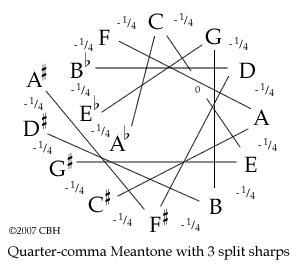
There is something simple that you can do for a little more versatility without rebuilding your keyboard, although the results may not be so pure. The trick is to split your wolf into two equal parts, which will allow your E♭ key to serve both as an E♭ and a D♯—equally compromized, but I hope eminently usable. You will, however, lose one pure third (E♭–G).
Try it by modifying your usual Quarter-comma Meantone. You must flatten your e♭ which was initially found by tuning a pure third below g, until in your opinion both the Major thirds from b–d♯ and e♭–g are usable. Both will be on the wide—and wild—side, but not as bad as the massively out of tune and hence unusable b–e♭ you had before. It’s a handy trick that might just get you out of trouble one day.
 Check the circle of fifths diagram where you can see I’ve had to respell the offending
note on your keyboard because it now serves a dual purpose: It’s become neither
an absolute E♭ nor D♯,
but a lousy both.
See the difference by putting your mouse over the diagram and then removing it.
Check the circle of fifths diagram where you can see I’ve had to respell the offending
note on your keyboard because it now serves a dual purpose: It’s become neither
an absolute E♭ nor D♯,
but a lousy both.
See the difference by putting your mouse over the diagram and then removing it.
Depending on your requirements, you could have retained your E♭ instead, and split your G♯ to provide an G♯/A♭ compromize.
Next, let’s see what a Frenchman did to make his meantone more palatable.
 |
Pitch nomenclature |
|
Harpsichord Tuning Process |
|
Tuning Bibliography |
|
Technical Library overview |
|
Harpsichords Australia Home Page |

 In the diagram at the left, I’ve tried to portray the three-dimensional
nature of this arrangement in only two dimensions, resorting once again to
the spiral. The possibilities of the wonderful intonation of three additional
pure major thirds are clearly shown by the straight connecting lines. Those
personality types inclined towards pessimism, though, may enjoy pointing
out that as a result there are now four wolves to avoid: The original g
In the diagram at the left, I’ve tried to portray the three-dimensional
nature of this arrangement in only two dimensions, resorting once again to
the spiral. The possibilities of the wonderful intonation of three additional
pure major thirds are clearly shown by the straight connecting lines. Those
personality types inclined towards pessimism, though, may enjoy pointing
out that as a result there are now four wolves to avoid: The original g