Technical Library
TEMPERAMENTS VIII: Quarter-comma Meantone
Entire Contents Copyright © 2020 CBH

Technical LibraryTEMPERAMENTS VIII: Quarter-comma Meantone Entire Contents Copyright © 2020 CBH |
|
 WIKIMEDIA COMMONS / PUBLIC DOMAIN |
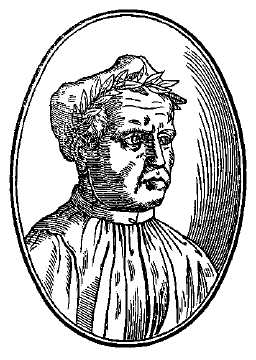
| Pietro Aron (c1480–after 1545) |
 Fasten
your seatbelt for Meantone now: This term is too often misused for any
sort of temperament other than Equal, but by itself really refers to the Quarter-comma Meantone system as first roughly described
by Pietro Aron (c1480–1545) in his Toscanello in musica (Venice, 1523).
Fasten
your seatbelt for Meantone now: This term is too often misused for any
sort of temperament other than Equal, but by itself really refers to the Quarter-comma Meantone system as first roughly described
by Pietro Aron (c1480–1545) in his Toscanello in musica (Venice, 1523).
With the right choice of repertoire, the human ear is overcome by the absolute beauty of the eight pure Major thirds Quarter-comma meantone offers, and once accustomed to this sound, any other temperament seems vastly inferior. It is especially useful for a lot of virginal music, Frescobaldi, Sweelinck, and Louis Couperin—and I certainly can’t tolerate listening to the multiple keyboards of a Monteverdi or other early Italian opera tuned any other way.
To tune Quarter-comma meantone from scratch, see below. But if you are working again from your Kirnberger III base, here’s how to morph it successfully:
1. Instead of determining all the notes outside the C to E on the circle by tuning pure fifths as you did in Kirnberger III, find them by tuning absolutely pure thirds. The g♯, for example, is a pure third above e. (If you do most of your meantone tuning in the octave below middle c', you may find these pure thirds a little easier to hear.)
2. Find the c♯' a pure third above a, and the f a pure third below a.
3. The b will come from the g, and tune down a pure third for the e♭.
4. Your f♯ comes from the d, as does the b♭ from d'.
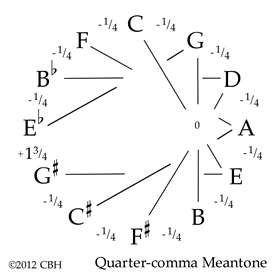
Once more, you’re done. Enjoy the peaceful sound of pure thirds in all the easy keys, but don’t try to play Brahms’ Waltz in A♭, or you will fall victim to the wolf: It is not a perfect fifth from G♯ to e♭, but a diminished sixth, and it sounds absolutely hideous. But instead of that, you should focus on the beauty of the many pure Major thirds: Look at all of them shown in the temperament diagram by those straight lines, and in the notation at the right.
 There are in fact three key colors in Quarter-comma meantone—as in any of these regular meantones; good, bad and ugly. As expected, the good triads are the ones with the pure Major thirds. The ear focuses on these thirds, and forgives the very narrow Quarter-comma fifths which sound out of tune if played by themselves. The triads for the bad keys contain a misspelt note: B–E♭–F♯, for example, instead of the correct B–D♯–F♯. There is a considerable difference between a sharp and its corresponding flat in this temperament, the sharps being much lower. Each chromatic note is very obviously derived from its natural, the distance between C and C♯ being audibly far nearer than C♯ to D. The downright ugly key is the single triad containing the wolf, where every note is misspelt: G♯–C–E♭.
Here’s where you can get into trouble if you have been following all the tuning directions so far and beginning your temperaments from c'', because sooner or later your diverse instrumental pals—instead of being overcome by the beauty of your harpsichord tuning—are going to politely complain about how flat your a' is, the traditional note most instruments tune from. (Nowadays supposedly the standard A440, although often creeping higher. For our modern baroque convenience, a halftone lower at A415.)
You can eliminate this ensemble conflict by starting your Quarter-comma Meantone from the usual a' tuning fork, tuning down the octave to a, then the pure Major third down to f. Divide that f–a third into your four quarter-comma narrow fifths, making f–c', g–d', c'–g' and d'–a' sound equally rough. Finally, find the remaining notes in pure thirds from those you have already tuned: Tune c♯' a pure third above a; the b from g, and down a pure third for e♭; your f♯ comes from the d, as does the b♭ from d'; and finally the e' a pure third above c' and the g♯ a pure third above that.
If you want to play in keys further afield, you can still do so in Quarter-comma Meantone, but you must either be prepared to retune a little, or fiddle around trying to reduce the effects of the wolf. We can examine some possibilities next.
Further discussion
Anonymous [Kayano, Moxzan] Dodecagon — Chi-s akt temo Tokyo 2012, p19
Asselin, Pierre-Yves Musique et Tempérament Éditions Costallat, Paris 1985, p75
Barbour, J Murray Tuning and Temperament Michigan State College Press, East Lansing 1951, p26
Jorgensen, Owen The Equal-beating Temperaments The Sunbury Press, Raleigh 1981, p16
Klop, G C Harpsichord Tuning Werkplaats voor Clavecimbelbouw, Garderen 1974, p12
Kottick, Edward L Harpsichord Owner’s Guide University of North Carolina Press, Chapel Hill & London 1987, p152
Padgham, Charles The Well-Tempered Organ Positive Press, Oxford 1986, p50
Veroli, Claudio di Unequal Temperaments Artes Graficas Farro, Buenos Aires 1978, p41
Zuckermann, Wolfgang Joachim The Modern Harpsichord, New York 1969, p243
 |
Pitch nomenclature |
|
Harpsichord Tuning Process |
|
Tuning Bibliography |
|
Technical Library overview |
|
Harpsichords Australia Home Page |