Technical Library
STRINGING I: String breakages
Entire Contents Copyright © 2010 CBH
Technical LibrarySTRINGING I: String breakages Entire Contents Copyright © 2010 CBH |
|
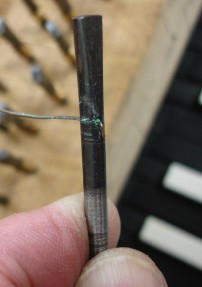 |
| All the brass
strings were breaking in this famous make of harpsichord because of chemical residue from the tuning pin blackening. |
Why do strings break?
While the steel wire used for the treble in the nasty old days of the harpsichord revival was virtually indestructible, most of the instruments made today use much softer wire modeled on historic principles.
Even so, today’s fine instruments don’t break strings that often, and rarely without cause.
Here are the most common reasons strings break on good instruments. All except the last can be avoided:
Very rarely, a bad batch of wire can be encountered. You should always speak to the maker of your instrument if you are concerned about broken strings.
Unlike guitar strings, the professional stringing of a harpsichord should last a decade or far longer. To prolong the life of your strings, keep the instrument in regular tune, remembering to play the note while you are tuning to make sure you are on the right pin! Avoid touching the strings, and keep the harpsichord lid closed when you are not playing.
 |
KEEP YOUR FINGERS OFF THE STRINGS: TOUCH THE KEYS INSTEAD! |
Remember that the soft wire most makers are now using for tonal reasons will break like a thread if kinked or mishandled in any way. Keep enough wire on hand for the odd emergency (especially the smaller sizes of brass for the top strings of the crossover) and store the coils tidy and dry. Replacing a broken string is a handy skill.
 |
 |
String breaking Carey Beebe demonstrating four easy ways—intentional or not—guaranteed to break a harpsichord string. |
 |
 |
Technical Library overview |
|
Harpsichords Australia Home Page |