Technical Library
STRUCTURE IV: Bridge detachment
Entire Contents Copyright © 2011 CBH

Technical LibrarySTRUCTURE IV: Bridge detachment Entire Contents Copyright © 2011 CBH |
|
Bridge detachment…
The glue joint between the bridge and the soundboard is subject not only to the combined tension of the strings over the years, but also the stress of expansion and contraction the soundboard must undergo with changes of humidity. In older instruments, it can sometimes be noticed that the glue itself has broken down and lost strength with age. The relatively rigid bridge has no choice but to pop off the flexible soundboard.
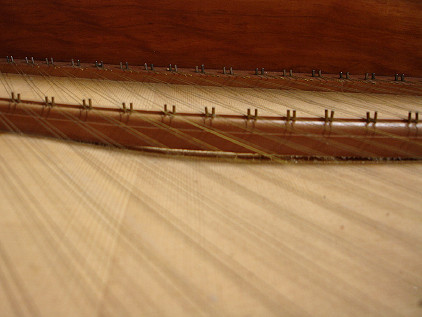
A region of particular trouble is the treble curve, where makers need to take special care during assembly that the bridge is glued flat to the board and does not roll towards the bentside. In simple cases, poor tone or lack of tuning stability will result. It’s not uncommon for a bridge to give way entirely, which obviously renders the instrument unplayable because the complete stringband loses its alignment to the action.
The bridge is usually the first item glued to the soundboard when the instrument is being built. The underside furniture is then glued, and the soundboard installed in the case. In a completed instrument, access is not always easily gained to provide support to the soundboard while the adrift bridge is being reattached. In such cases, it can be possible to drill holes through the bottom for temporary supporting dowels directly under the line of the bridge. Virginals or clavichords with large mouseholes can often provide sufficient access for props to reach from the instrument bottom to the underside of the soundboard while clamping pressure is provided from the top.
 |
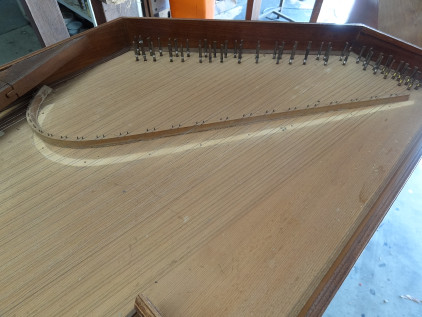 |
| Partial detachment of an Italian bridge around treble curve | Virginal with completely detached bridge |
 |
 |
Reattaching the bridge Carey Beebe reattaching a virginal bridge to its soundboard. |
 |
 |
Technical Library overview |
|
Harpsichords Australia Home Page |