Technical Library
ACTION XI: Dampers
Entire Contents Copyright © 2010 CBH

Technical LibraryACTION XI: Dampers Entire Contents Copyright © 2010 CBH |
|
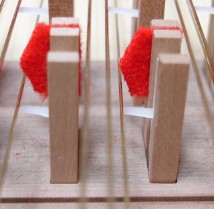 |
| 4´ flag dampers |
The Four-foot Dampers
For extra resonance, some instruments can even bear to have the dampers removed
on the four foot choir down to middle c', and if you cut the remainder like little
flags so that it is the side of the cloth rather than the bottom which stops
the string, you will have added bloom.
To cut the flags, use sharp scissors. Or some use diagonal nippers (wire cutters). Firstly, push the damper cloth all the way to the bottom of the slot—it must be below the plectra to work! Hold the jack sideways with the plectra closest to your face and damper below—you can then judge the approximate position of the string and vary your angle or amount of offcut accordingly. Two nips will do it, the first at 45°, cutting from the middle of the damper side down to where it meets the jack body, or somewhat away from the body if you have nice long quills. The second cut trims the top likewise, and leaves a semaphore-like flag so the top of the damper won’t foul the 8´ strings. This is especially handy in those instruments with the 4´ pinned almost underneath the 8´.
Try a few and see if you like it before you cut the whole lot. Damper cloth is cheap, but if you happen to cut a little too much off one, it can sometimes be nudged a bit forward in its slot.
Some of my colleagues don’t like leaving dampers out, or even cutting flags: It does make transposition a little more tricky. They prefer to have all the jacks hanging from their dampers for security.
And then there was the violinist client who was so used to a dead instrument. When it suddenly came alive with this simple and effective resonance treatment, she rang around all the keyboardists to make sure it was appropriate and she wasn’t being fleeced: She was worried about the harpsichord still sounding the D Major of the previous bar when she was into some subsequent tonality…
Damper Curl
Watch out for damper curl, which can happen too easily if your jacks hang from
their dampers instead of sitting on the keys, or if your cloth is too thin. In
the steel-strung twentieth-century instruments especially, watch for the little
grove that years of pressure will wear in the damper material: Use your needle-nosed
pliers to pull the damper out and replace it upside down.
 |
 |
Inserting the 4´ dampers Carey Beebe inserting & trimming the dampers for the 4´ choir of a French Double Harpsichord. |
 |
 |
|
Inserting the dampers — Time-lapse Time-lapse of Carey Beebe inserting the dampers in the front 8´ jacks of a French Double Harpsichord. |
|
 |
Technical Library overview |
|
Harpsichords Australia Home Page |